
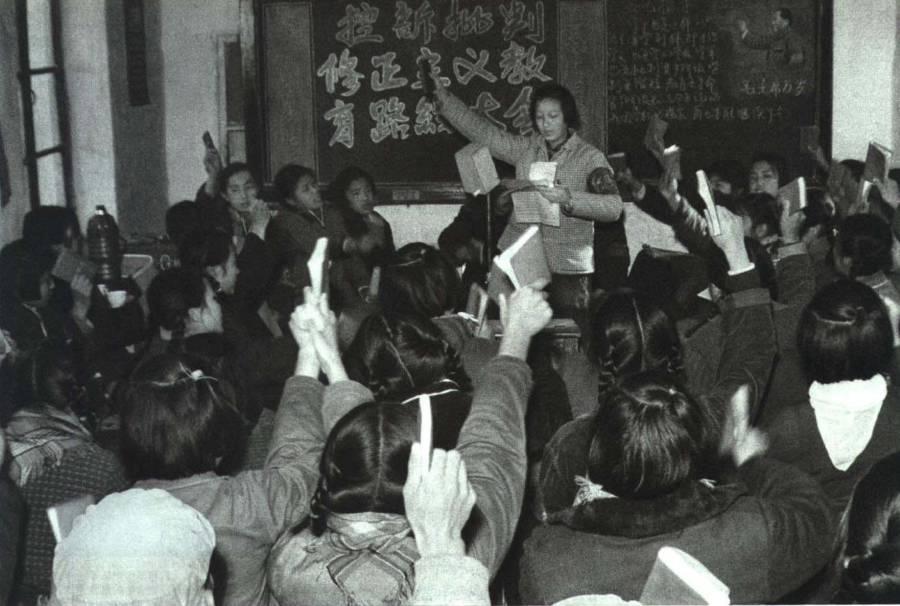
We are happy to publish on the anniversary of Chairman Mao Tse-Tung’s article ‘Combat Liberalism‘ this guide to criticism and self-criticism. We hope that it will help build disciplined comrades out of activists newer to our movement and strengthen those already working alongside us. The guide is available as a printable zine for broad dissemination. To print, be sure to click the settings for ‘double sided’ and ‘flip on short edge’
This paper is a collection of thoughts and writings of past revolutionaries and revolutionary organizations, lightly edited and structured with the current
movement and its needs in mind.
Revolutionary students throughout the country and the world are proving to be an important motive force of great political and social significance as they continue to exhibit a tenacious and militant stand against capitalist-imperialist oppression.
Through arduous struggle and willingness to join hands with the masses of oppressed people, they are clearly showing that, indeed, the future is bright – the trend of socialist revolution is inevitable and irreversible!
Introduction
Individuals who belong to revolutionary organizations that are seeking and working toward the seizure of Power by the working class must not only study the theory and practices of other revolutionaries, but must carefully study our own experiences and draw conclusions from those experiences that will help others. This paper is based on long experiences in the revolutionary struggle inside the united states, collective discussions, wide reading of the revolutionary experiences of others, intimate knowledge of many organizations in the united states, and intense personal experiences in the past and currently as we struggle with many comrades as they struggle with us.
People are urged to discuss and expand upon the contents of this paper. It must always be stressed that not written or spoken word is the definitive statement upon any subject, but only a guide for action, learning, discussion, and further exploration. All of us must strive to contribute to revolutionary theory by summing up our experiences and drawing lessons for the future. A revolutionary learns a great deal from their mistakes.
To wage ideological struggle does not only mean to try to convince those outside of revolutionary organizations, but the internal struggle in organizations and within people is a continuous process. Revolutionaries must constantly be on guard for tendencies inside a revolutionary organization that will lead to its destruction and a setback of the revolutionary process. Constant vigilance must be exercised and corrosive tendencies fought vigorously at the time they begin to spring up.
Every revolutionary pamphlet, article, essay, memorandum, circular, communique, or book is written to serve a need. This paper is written to consolidate the thoughts of many revolutionaries into a weapon to fight the reactionary tendencies among our own ranks and our own selves. These tendencies are manifested in many of us, and in some more than others. Many organizations have failed to raise to a level of discussion many of the ideas and methods contained in this paper and, as a consequence, revolutionary struggle is not proceeding at the pace it should or could be if internal struggle were waged around reactionary and counterrevolutionary tendencies.
Back-biting, underhand tactics, gossip, rumors, incorrect statements, and laziness are just some of the destructive tendencies that plague some organizations that seek to honestly call themselves revolutionaries. Struggle could be and must be wage within individuals who manifest these tendencies and others, but the tendencies themselves must be exposed and all efforts must be made to correct them. Without the struggle to eliminate the causes, other comrades will be vulnerable to the same errors and we will find ourselves constantly fighting “the enemy within” rather than imperialism.
The revolutionary struggle in the united states, however, is mounting each day, and many people are learning revolutionary theory and trying to struggle with themselves and their comrades. We live in crucial times, a time when we must work to mobilize more and more people to the world-historic, arduous, revolutionary struggle.
Criticism and Self-Criticism
Criticism in the positive usage is the examination, analysis, and evaluation of the comparative worth of one’s acts, practices, policies and/or ideas by others. Self-criticism is of course this same principle applied to oneself, but it also refers to the practice of an organization critically examining and re-examining the policies and/or practices of its own members. Criticism and self-criticism are wholly necessary to human progress. Revolutionary theory elevates positive criticism and self-criticism to a conscious principle and incorporates it into the daily operational procedure of the organization.
Criticism in its positive usage corrects/adjusts mistakes of practice and of thought, resolves differences among individuals and makes for a smooth-running, well-functioning organization. Chairman Mao Tse-tung, in his discourse on criticism, put forth the slogan “Unity-Struggle-Unity” to show how individuals come together and unite under one principle or set of principles, but in the actual working out of these principles differences arise for various reasons which militate against the accomplishment of declared ends, and against cohesion of the organization. When these differences arise there must be struggle in which those with differences interpenetrate, modify one another, and form a new and more perfect unity on the basis of having worked out contradictions that were inherent in the old unity.
I. Causes of Error
The differences which arise that disrupt unity can generally be found to have their basis in these three categories of human errors:
1) Opportunism1: Opportunism is defined as that tendency for an individual or individuals to make a decision or commit an act that is favorable to their own self aggrandizement and at the expense of the collective or the movement as a whole. Opportunism stems from selfishness and petty individualism. When opportunism arises, either in an individual or in an organization, it is to be severely criticized and if necessary the individual or individuals expelled from the organization or ostracized from the movement.
2) Subjectivism: The second type of error that disrupts unity and impairs revolutionary progress may be found in the general category called “subjectivism”. Subjectivism can be distinguished from opportunism often only by the thinnest of lines. It generally has to do with personality flaws. One makes a decision or commits an act that is based on one’s personal feelings, desires, resentments, jealousies, prejudices, etc. Such subjectivism may possibly stem from any number of sources: childhood trauma, subliminal conditioning, religious superstition, etc. When such subjectivism arises to impede the functioning of the individual or the progress of the organization, it is imperative that it be dealt with. The consciousness of many must necessarily be stripped of the old pernicious ideas and values imbued by the bourgeois culture. Though again Chairman Mao cautions that those traits and personal idiosyncrasies which are not particularly harmful to the individual or the cause, but are largely a matter of style, should not needlessly be criticized.
3) Errors From Objective Causes: Thirdly, there is the type of error that stems from objective causes. For example, one may have lacked certain objective information, or may have placed too heavy an emphasis on certain elements of a situation rather than other more correct elements. Perhaps the environmental conditions themselves may have been such as to limit the formulating of a more correct idea or policy: this last type of error is the type that a group or collective will inevitably find itself dealing with again and again. That is to say, most persons coming into a collective can be expected to more or less quickly grasp the rules against opportunism and subjectivism (though from time to time these problems too must necessarily be dealt with) and subscribe to a revolutionary outlook which in its concreteness means analyzing a situation with the objective facts of the situation uppermost in mind. But the objective factors of a situation are continually undergoing change as the old elements and factors fade and diminish and new elements appear. Hence, policy and practice must be re-examined periodically, and new policy made to account the changes in the situation.
Professionalism is said to be distinguished by “no wasted motion” – that is by making the least mistakes. To be a revolutionary organization is to be a professional organization, which means errors and excessive baggage
II. Negative Criticism
But perhaps another way to get indication of the value of positive criticism is to compare it with the bourgeois use of criticism, or negative criticism.
At the base of the difference between the bourgeois use of criticism and the socialist (proletarian) use lies the false ideological emphasis on the individual rather than on the collective. As a result, for the bourgeoisie with their emphasis on individualism, criticism inevitably is negative. It is not used to build, rather to destroy. It ceases to be a tool by which to correct and adjust mistakes or resolve differences and repair breeches in unity; rather it becomes a weapon of assault, a tool of domination, of one personality upon another. Itis divisive and destructive; it is nit-picking and slanderous, an attack upon the intrinsic worth of an individual.
Such a use of criticism is typical of the alienated minds which emanate from bourgeois culture. Thus, we see the “strong” personality exalted; the dictator who brooks no opposition, the patriarch that tolerates no criticism, the tyrant whose dictum must be obeyed without question. Of course, in the final analysis it must be pointed out that such creatures of alienation are not due solely to aberrations in bourgeois philosophy, but are inherent to the imperatives of class society and systems of alienated labor.
In primitive societies which were communistic, in that the means of production were held in common by the whole tribe or community and exploitation of one individual over another did not exist, we generally find criticism instituted to the more or less democratic plane which revolutionary theory has adopted.
A revolutionary organization that does not utilize criticism and self-criticism is not Marxist-Leninist. Chairman Mao advised, ” …constantly expand the Red Army and enhance its quality through struggle so that it can fulfill its mission in the coming general insurrection.”
Criticism is one of the types of struggle that enhances quality. The group or collective that does not conduct criticism but allows mistaken practices and ideas to go unchecked builds up a subjective undercurrent that ultimately must destroy it in a whirlwind of crisis. A revolutionary organization may be compared to a battering ram that pounds away at the fortress which is the system. If the substance of the battering ram is lesser than the substance of the system we may expect the battering ram to break and shatter. In working out the contradictions through critical examination and expulsion of negative traits, an organization like a rock without flaws becomes more and more solid, more and more able to withstand the shocks and blows inherent in revolutionary struggle.
If the system on the other hand is moribund with contradictions, we may therefore expect it to break and shatter at the impact of our revolutionary thrust. Only through struggle with the latent contradictions of individuals and objective errors of the organization can a collective hope to enhance its quality and fulfill its revolutionary role “..in the coming general insurrection.”
III. How to Conduct a Struggle Session
In conducting a struggle session we find that these few broad rules apply:
- CRITICISM NOT BEFORE THE COLLECTIVE:
Mannerisms of a subjective nature which are minor and inconsistent with organizational rules and principles may be dealt with privately by one comrade simply pointing out the error and inconsistency to the other.
The criticism should be acknowledged by the recipient and resolved at this point. - CRITICISM BEFORE THE COLLECTIVE:
a. Opportunism is a major departure from revolutionary principle and must be brought before the collective.
b. Subjective errors that persist after a criticism is brought in private should be brought before the collective.
c. All objective propositions that have to do with the organizational policy and practice, or that affect the Revolutionary Movement as a whole, should be brought before the collective. - Each criticism should be dealt with on its own merits; that is, do not bring up a criticism of another individual in order to divert attention from oneself (unless there is a direct connection between the two. Only after the original criticism has been resolved should another criticism be broached.
- No attack upon personalities or unprincipled criticism.
a. No name-calling.
b. No disparaging remarks about an individual (only about the acts of an individual).
c. Deal with the objective facts of a situation. - A criticism is not resolved until:
a. The person who is the object of the criticism acknowledges their error and states their intention to amend their ways, or
b. The person who brought the criticism acknowledges that the criticism was invalid, or
c. Some point in between is reached where that portion which is valid is acknowledged and that portion which is invalid is acknowledged as invalid.
COMBAT LIBERALISM
Throughout the process of educating the people (ourselves), certain contradictions will arise within the ranks that must be critically attacked and resolved in order to ensure unity. Therefore every comrade and revolutionary-in-formation should take up this weapon and use it judiciously. All of these contradictions can be listed under the heading of “liberalisms”
Here are some basic manifestations of liberalism:
- To let things slide for the sake of peace or friendship when a person has clearly done wrong and refrain from principled argument because of emotional feelings towards a comrade, or to touch on a matter lightly instead of going through it thoroughly, so as to stay on good terms. The result is that both the individual and organization is hurt.
- To indulge in irresponsible criticism in private instead of actively putting forward one’s suggestion to the organization. To say nothing to a person, but gossip behind their back, or to say nothing at a meeting but to gossip afterwards. To follow one’s own inclination with no regard for the organization’s principles.
- To let things go when they do not affect one personally; to say little when you know something is wrong, to be worldly-wise, play it safe and seek only to avoid blame.
- Not to follow directives but to give pride or place to one’s own opinions and reject organizational discipline.
- To indulge in personal attacks, pick quarrels, vent personal spite or seek revenge instead of entering into an argument and struggling against incorrect views for the sake of unity or progress, or getting the work done properly.
- To be among the masses and fail to conduct propaganda and agitation and show no concern for their well-being.
- To work half-heartedly without a definite plan direction and muddle along.
- To regard oneself as having rendered valuable service to the struggle and become narcissistically amused, thereby causing oneself to become alienated from the party and the people. To become so engrossed in theoretical analysis as to form an intellectual elite.
- To be aware of one’s own mistakes but make no effort to correct or admit to them.
Liberalism stems from petty-bourgeois selfishness; it places personal interest first and the struggle second, and this gives rise to ideological, political, and organizational incoherence. And again, the idea behind practicing liberalism is that if you are easy (liberal) on a comrade and allow them to get away with their manifestation of petty individualism, they will in turn be liberal when you display your petty individualism. Liberalism brings on personalism, resentments, prejudices, jealousy, and division.
- We should always qualify the definition of “opportunism” as being at the expense of the collective or of the movement as a whole. ↩︎

 Revolutionary Student Union
Leave a comment