
The Revolutionary Student Union hereby republishes these two articles from Frontlines, a publication started by our chapter at the University of Michigan, the League of Revolutionary Students of Washtenaw.
Flood the Belly of the Beast
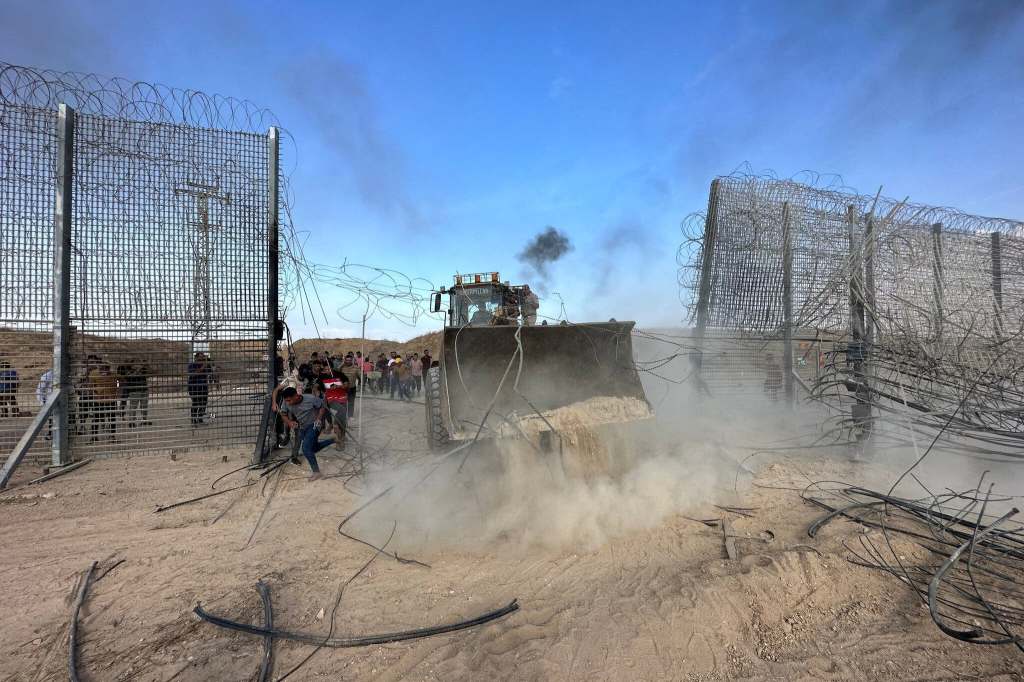
First, we find it necessary to establish that the wave of revolutionary action in support of Palestine, and the delivery of Palestine to the forefront of the global anti-imperialist movement, is a result of the brave sacrifice by the Palestinian people on October 7th, 2023.
With this article, we articulate five direct lessons for the student movement and broader mass movement in amerika, bestowed on us through the militancy and struggle represented by Operation Al-Aqsa Flood.
1. Escalation is the path to change
Palestinians affirmed during Operation Al-Aqsa Flood a universal truth that “political power grows from the barrel of a gun”.1 The resistance affirmed that it is through revolutionary violence that the walls of occupation can be smashed.
The essence of the flood was a channeling of the collective spirit of resistance of the Palestinian masses, an escalation from the 75+ years of breaking down walls. Towards the student movement, the collective spirit of our resistance towards the imperialist beast has formed cracks in the base of its ivory tower
The state of the movement in this country is far from the organization and militancy exhibited by the Palestinian resistance, however, we have gotten a small taste of this truth. The uprisings of the student intifada and various actions in defiance of America’s commitment to zionism and genocide were suppressed by violence. Organization and militancy demonstrated in a small number of cases that reactionary forces of police and administration can be expelled and defeated. Esclating and multiplying the militancy we saw during the student intifada and elsewhere is the only path forward, and the only one that leads us towards wielding substantial leverage on behalf of Palestine.
We must assess the failure of the student intifada, and the broader movement. We must take to heart the call of the students in Gaza to begin “a new revolutionary phase of comprehensive escalation.”2
Statements from Gazan students require us to reflect on the line between reform and militancy. We have a particular duty, as students in the imperial core, to not bend at the knees of opportunist politicians and movements, and to hold the line on truly revolutionary politics.
2. Our vision must extend beyond what the enemy imposes on us
Palestinians rose up on October 7th partly because they were able to channel their positive collective vision of breaking this siege and freeing Palestine into an act of revolutionary violence. Despite the abhorrent conditions imposed on them by the zionist settler-colony, they were able to maintain and concretize this vision.
We see this influence in media, where publications like the Detroit Free Press echoed the University of Michigan’s emphasis that “none of the people who were arrested were students” at a demonstration in September. Why are they saying this? To enforce a warped view of reality, that there are “good” students and “harmful” non-students who are leading the student movement astray. They need to intensify the effort to put a cleavage in our movement because a unified movement is what they fear the most. They would prefer it if students valued themselves over members of the community, workers, and others, and reproduced this rhetoric in the youth movement.
It is clear that with these efforts from our enemies, we must intensify our struggle against the mindset instilled by the universities. We must go look beyond our lives as students and partake in struggles in our broader communities. The student movement can only be successful should it link and subordinate itself to the broader revolutionary struggle.
The Palestinian revolutionary intellectual Basil Al-Araj’s correct analysis demonstrates that opportunism, bourgeois influence (in our case, this is mediated by the university administration), and capitulation work to “reproduce what preceded [the status quo] in new forms and with younger faces”.3 In the same way that Basil and the Palestinian resistance fought this reformist line in Palestine, so too must we in the student movement.
This point includes rejecting the active attempt to co-opt our movement. The effort to channel the collective rage of the pro-Palestinian movement into meager handouts from the University administration, or a vote on a meaningless ballot is something we must stand up against. It is no coincidence that some University administrations have begun adopting vague “pro-Palestinian” sentiments, they know it is a way to subdue a movement that threatens their power.
The Al-Aqsa Flood put forward the powerful lesson that we as revolutionaries must conceive of a vision for what a better society looks like, and draw from this vision to fight towards achieving it.
3. The revolutionary cause is a self-sacrificing and optimistic one
The mindset of the imperialists could not comprehend why Palestinians would take such a drastic risk to achieve even the slightest victory for their people. That is why in order to fulfill the warped view of reality the imperialists have, they created false narratives that the Palestinian resistance was motivated by murderous tendencies or some genocidal intention. The self-sacrificing attitude of the Palestinian resistance is intrinsically linked to the belief that sacrifice is for the purpose of a larger goal, a parcel of a larger movement towards change.
This is inherently optimistic. Understanding that our movement doesn’t stop with death, but keeps producing life. The struggle lives on in the hearts of the people and as ideas. As Palestinian revolutionary Sanaa Salameh beautifully put it, “We do not fear this [israel] country, as we produce life, while they produce death.”4
In the student movement, this is an attitude we must pay particularly close attention to. By no means are our sacrifices at the level of the Palestinian people, but we can still learn something important. For example, with the influence of the university and schools, it is easy to default to the pressure that our role is just to complete our studies with the hopes of securing a job. This is a deterrence to the type of work that needs to be done. Why risk arrest if it’ll threaten one’s prospects of getting into graduate school? The answer lies once again in what the Al-Aqsa flood represented. This risk is bearable because we are fighting for others, who will carry on with our ideas. These risks are necessary because it is only by daring to win that the masses have achieved anything in history.
We reject the tendency in the pro-Palestinian movement to avoid risks, to be overly pessimistic, and to cower in the face of repression. Assurance of victory should not be a prerequisite to struggle. Our enemy is stronger than us, but the Al-Aqsa Flood taught us that the myth of their infallibility can be shattered.
We must adopt the attitude of the self-sacrificing and brave Palestinian resistance if we want to achieve anything tangible here. We need to understand that their sacrifice finds its origins in a profound optimism and love for their people, for the cause. We must understand that this attitude should serve in the words of Catalina Adrianzén, Peruvian revolutionary, “as a starting point for a social change, it should be the stimulus for youth to struggle to build an egalitarian world without oppression or injustice”.5
4. Strategy is necessary to continue escalating
Taking up the historic call of the Palestinian resistance, a small portion of activists in America began escalating and unleashing the combative spirit of people rightfully enraged with their government’s support for genocide. In opposition to this, a large portion of the so-called “Pro-Palestine” movement was and is stuck in a cycle of repeating the same tactics, strangling the potential for escalation and militancy, and not working to reach the broadest strata of the masses.
We owe the Palestinians with providing a resurgence to an anti-imperialist movement in this country, but it is up to us to develop it towards truly revolutionary means. We put forward the correct conception that escalation and organization form a contradiction. What does this mean? It means that escalation is only possible through mass work, outreach and sometimes grueling efforts to mobilize masses of people, and that escalation in turn develops those who have been organized and brings us closer to the goal of stopping this country’s support for genocide. In essence, what needs to happen is a strengthening of the movement in both quality and quantity, without neglecting one over the other.
5. We must draw a line of demarcation
What is a line of demarcation? It is making it clear who are our (potential) allies, and who are our enemies. A figurative line that distinguishes us from those who oppose us. It is taking action against our enemies and taking action to build and care for our movement.
This distinction is far from being clearly made in our movement. The student intifada was met with a wave of capitulation, that is student movements giving in to their administration for less favorable demands. Hence, work needs to be done to delineate who our enemies are. Should the relationship between pro-Palestinian students and administrations who support genocide be one where we can freely dialogue and try to negotiate, or should it be one where we build enough power and escalate to the point where it is impossible for the administration to ignore our demands?
Operation Al-Aqsa flood makes this answer clear to us. Decades of negotiations, peace talks, normalization, and even elections were ineffectual in the face of what proved more successful in shattering the illusions of the zionist entity – escalation, militancy, and revolutionary violence. How does this translate to the student movement? It tells us that we must rely on our own power and develop this power, rather than begging for scraps from our enemies (the administration, the ruling class).
Students in the Pro-Palestinian movement, do not let the sacrifice of the Palestinian people be in vain. The obligation of every revolutionary is to cut off the head of the snake, the cause of the misery of a majority of the people worldwide, to bring down the imperialist system from within. This is a historic task, and will require much more mobilization, politicization, and organization. Students, we must struggle to look beyond the outlook instilled in us by the university, we must dedicate ourselves to partaking in struggles beyond the campus walls. We must build towards the capacity to flood the halls of the university, breaking down its walls and building something truly for the people.
FLOOD THE CAMPUS
BREAK DOWN THE UNIVERSITY WALLS
THE STUDENT INTIFADA LIVES
1. https://www.marxists.org/reference/archive/mao/works/red-book/ch05.htm
4. https://peoplesdispatch.org/2024/05/25/sana-daqqah-we-are-on-the-side-of-humanity/
Yahya Sinwar Lives
“I have fought all my life for my people to be free and have a normal life. I do not give up. I keep going, and so do my people.”
“Now the time has come, mother. I saw myself storming their positions, killing them like sheep, then becoming a martyr. I saw myself in the presence of the Messenger of God, may God bless him and grant him peace, in the gardens of bliss, as he shouted to me, ‘Welcome, welcome!’”
-Yahya Sinwar
Yesterday, Yahya Sinwar flooded the world once again, this time in images, following his ascension into the immortal glory of his role as a hero and leader of the Palestinian resistance. Despite the objective circumstances of his martyrdom, we say that Yahya Sinwar lives. Following the lead of the resistance, we celebrate this martyrdom. Sinwar once quoted Imam Ali saying, “There are two days in a person’s life: the day when death is not your destiny, and the day when death is your destiny. On the first day, no one can harm you, and on the second day, no one can save you.” Sinwar embodied a remarkable understanding of his role and his fate, and there is no doubt he was prepared for this moment.
The Real Face of Yahya Sinwar
Presently, the imperialist media crucifies Sinwar. In the face of their lies, we hope to present the true face of a man who fought relentlessly for his people.
The common narrative is that Sinwar, public enemy number one of Western imperialism, was a murderous hitman fueled by genocidal intent. This reflects the imperialists’ inability to fathom the courage and conviction it takes to stand up for a people set against the ravenous interests of their empire. Such action can only be sustained by an abiding kind of love. Despite obfuscation by zionist propaganda, Sinwar has always made his true motive clear, “All [the children of Gaza] have known in their lives is siege and aggression. I want them to be free.” Sinwar refused to accept the zionist narrative that the resistance is responsible for the suffering of Palestinians, declaring “the one responsible is the one who closes the doors on 2 million people, prevents them from receiving medicine and food, and deprives them of job opportunities and a decent life.” Sinwar’s goal, to each tactical objective, was grounded in the righteous struggle to lift the siege of Gaza, a task that remains accomplishable only through steadfast resistance.
The intensity of Sinwar’s burning desire to free his people was matched only by the beauty with which he articulated the substance behind the resistance, for which he came to bear great responsibility. The humanization of Sinwar and his people’s struggle has always been absent in their mainstream coverage: it is in the interests of the imperialists to paint the resistance in the most inhumane light as possible. We choose to look to Sinwar for insight on this neglected aspect:
“I have been in prison for 25 years”, Sinwar points to one of his advisors, “Bassem lost a son who was killed in an Israeli airstrike. Your translator lost two brothers. The man who served us tea: His wife died of an illness. It wasn’t a big problem. There were cuts, but there were no antibiotics. That’s how she died. Any pharmacist can treat that. Do you think that’s easy for us? Let’s give our children the freedom and life that we never had. They will be better than us. More capable of building their future and the future of their country and contributing to the service of humanity. Depriving our people of their rights for decades is what has prolonged the conflict and brought destruction to the region. Don’t deprive future generations of these rights.”
Perhaps it is all too easy for us to understand the desperation with which the enemies of Palestine must have acted to keep this side of Yahya Sinwar a secret from the bulk of the Western world. Is there a loving parent alive who would fail to see themself in Sinwar’s dearest revealed wish, to hold his “son Ibrahim’s hand and go buy him something from the store or the market, just like any father and son. [To] take my children on a beach trip to play with them on the sand, far from the eyes of the enemy and the security measures.” Is there a loving parent alive who would fail to recognize the inescapable responsibility of fighting for the future of one’s children?
We must also celebrate Sinwar’s lifetime of resistance prior to his fatherhood. Few know that Sinwar was first arrested at the age of twenty, following his involvement in the Islamic bloc student movement at the newly founded Islamic University of Gaza. Today, many Palestinian students are held in administrative detention just like Sinwar, demonstrating his atemporal oneness with the will of the Palestinian cause, and the undying struggle against siege and occupation.
Sinwar endured decades of torture and brutality in the zionist prisons. Rather than allowing his soul and spirit to be crushed by the abhorrent circumstances in which he found himself, Sinwar transformed his imprisonment into a trench of combat. Withstanding interrogation and torture, he took the opportunity to study the enemy. During his time in prison, Sinwar achieved the remarkable feat of teaching himself Hebrew, and engaged in an extensive study of the enemy’s repressive security system. Translating the books of the occupiers into Arabic, he also wrote the book “Al-Majd”, detailing the occupations security apparatus and intelligence efforts. It is in this book that he also wrote about methods of investigation of Palestinian political prisoners. Sinwar was a living, shining example of the struggle for freedom of political prisoners, his own freedom the result of his incredible will behind the bars of occupation, and the political victories brought by resistance. A zionist interrogator who was tasked with questioning Sinwar once remarked that Sinwar told him defiantly, “One Day I’ll Be in Power – and You’ll Be the One Interrogated”. Despite Sinwar’s martyrdom, this still rings true. The cause that beckoned Sinwar’s martyrdom will one day interrogate and inflict justice upon the agents of zionism and its participating war criminals, who are doomed to the abhorrence of history and humanity.
Prior to his release from the occupation’s prisons, Sinwar wrote and published a fiction novel in 2004, “Thorns of Carnations.” He painted a beautiful and humanizing picture of the struggle from 1967 to the Al-Aqsa Intifada, blending his own memories with the narrative of this struggle. Sinwar’s ability to portray this struggle is profound: the art that flowed through him began with the people, and thus must return to the people. He emphasized at the beginning of his novel that, “Everything else is real; I have lived it, and much of it I have heard from the mouths of those who did themselves.” Through the fiction piece, Sinwar was able to promote the historical trend towards liberation while emphasizing its generation by the Palestinian masses, and their real experiences. The novel also combats the imperialist narrative that Palestinians and the people under siege are “animalistic” and unable to intellectualize their conditions, much less form wise leadership of their resistance: “I would like to point out that despite all the suffering experienced by the Palestinian people, their love of life has made them one of the most educated peoples in the region.”
Recent polling indicated that Yahya Sinwar earned overwhelming support from Palestinians in the West Bank and Gaza to serve as the leader of the Palestinian national movement. This exposes the bankruptcy of imperialism, who posits support on the basis of “democratic means”, but ignores the democratic will of people who oppose its aims. This moment affirms Mumia Abu-Jamal’s analysis that corporate journalism is all about “selling soap”, thus structurally incapable of portraying unprofitable truth. We emphasize the enormity of our responsibility, to develop our own journalism and news to circumvent the propagandistic obstruction of anti-imperialist truth: a truth that is already apparent to the majority of people in the world.
Sinwar and his Significance to the Undying Struggle Against Imperialism
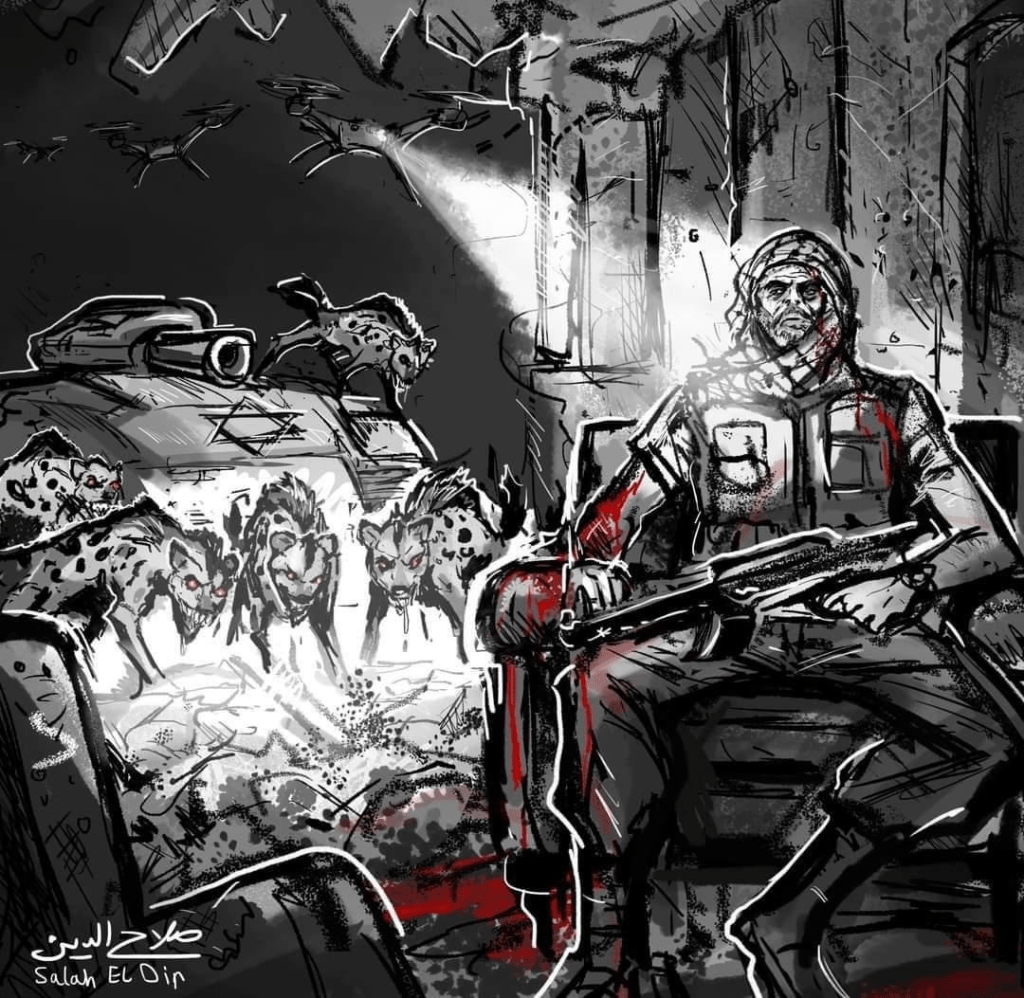
Sinwar’s martyrdom, celebrated by the imperialist media and zionist lackeys as a sadistic indication of the victory of their genocide, is celebrated by us, with more force and guts, for the the opposite reason: Sinwar died next to his pistol and covered in dust, a kuffiyeh wrapped around his head. Sinwar’s martyrdom, the final chapter of his lifetime’s struggle, embodies the resistance that flowed through him. Sinwar’s struggle began with the people, and thus must return to the people. We celebrate its return, while the old order furiously claws against the inevitable developments and transformations that will sweep it away. In nature, this phenomenon is clear, animals on the brink of death unleash an unforeseen ferocity.
“There are two days in a person’s life: the day when death is not your destiny, and the day when death is your destiny. On the first day, no one can harm you, and on the second day, no one can save you.”
The zionist entity closes in upon that second day, whereupon no amount of ferocity can save it from the people it has terrorized.
The zionist entity and the imperialists have released images of Sinwar in his final hours in hopes of demoralizing the Palestinian resistance and its cause. On the contrary, these images serve as a beacon of heroism and inspiration for the resistance of today and of future generations. Unlike the cowardice that marks the leaders of the zionist entity and the imperialists who cower at the face of the resistance, Sinwar was unafraid to face the enemy head-on. Shattering all myths that the resistance “hides behind civilians”, the images and circumstances of Sinwar’s martyrdom proves that the resistance is on the frontlines against the enemy, acting as the first barrier between genocidal forces and the whole Palestinian people. Sinwar’s martyrdom proved beyond doubt his incredible courage and will, fighting with blood and soul until the very end.
You will see many interpretations, condemnations, and opinions of Sinwar in the coming days. The truth is his martyrdom represents a life of sacrifice, struggle, and contribution to a struggle greater than himself. Sinwar knew this, and his dedication to the struggle for the liberation of Palestine is the best indication of such. His martyrdom, on the frontlines, wielding a weapon against the enemy embodies the powerful will of the Palestinian people, a will we should all seriously resolve ourselves to take inspiration from. Cowardice is for the weak, for those whose cause is not righteous, whose cause does not push humanity forward. The ability to face death only comes with a righteous cause, with knowledge that what you fight for lives on. Sinwar was a guide and maker for tomorrow, his martyrdom constituting his full embrace of a cause that belongs primarily to the people of Palestine, but also to the liberation of all of humanity.
Heed Salah Jahin’s verse:
ياما العدو راح يـشـوف (Oh how the enemy will suffer)
منكـم في نـار المـيـدان (From you in the fire of the battle)
والله زمــان يـا سـلاحـي (By God it has been a long time, my weapon)
Honor and Glory to Yahya Sinwar!
With blood and soul, fight to the very end!
Yahya Sinwar Lives!

 Revolutionary Student Union
Leave a comment